
Sanitary pad safety has become a growing conversation across Nigeria, particularly on social media.
Women and girls are asking important questions about the menstrual products they use every month:
What is actually in sanitary pads?
Can certain ingredients cause irritation?
Should we be concerned about chemicals detected in menstrual products?
These are valid questions.
But they need to be answered with evidence, not fear.
At BlossomFlow Empowerment Foundation, we believe menstrual health is not only about access to sanitary products. It is also about safety, dignity, informed choice and trustworthy information.
Key Takeaway
Recent research has detected certain chemicals in some menstrual products, including sanitary pads.
However:
Detecting a chemical does not automatically mean that normal use of the product causes illness.
Risk depends on factors such as the amount present, level and route of exposure, frequency of use and the properties of the substance involved.
Current evidence does not support telling women and girls to stop using sanitary pads.
What the research does support is the need for:
- Better product transparency
- Stronger monitoring
- Independent testing
- More research focused on African populations
- Clearer information for consumers
The World Health Organization also notes that there are currently no global safety standards ensuring that all locally or commercially produced menstrual materials are safe, high-quality and free from harmful chemicals.
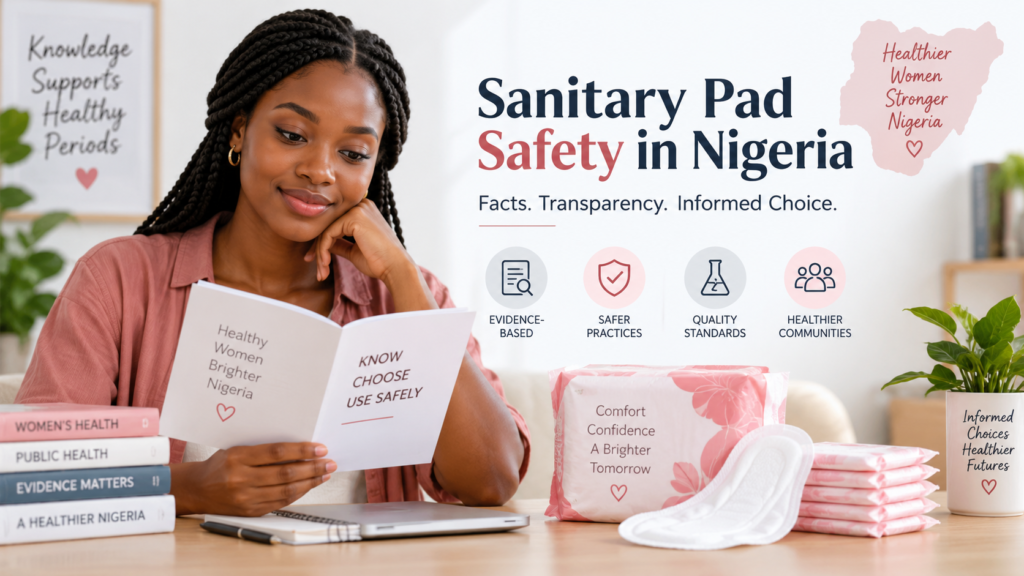
Why Is Sanitary Pad Safety Being Discussed?
Sanitary pads remain in close contact with sensitive skin for several hours at a time and are used repeatedly over many years.
Because of this, researchers have increasingly examined substances that may be present in menstrual products.
These can include:
- Phthalates
- Fragrances
- Parabens
- Heavy metals
- Volatile organic compounds
- Dioxins and related chemicals
Some studies have detected these substances in menstrual products.
But there is an important distinction:
Presence does not automatically equal danger.
Scientific risk depends on how much of a substance is present, how a person may be exposed to it and whether that exposure reaches a level associated with harm.
That distinction is essential when discussing sanitary pad safety responsibly.
What Has Nigerian Research Found?
Recent Nigerian studies make this conversation particularly relevant. These findings are contributing to the wider conversation about sanitary pad safety in Nigeria and the need for further research.
Phthalates in Sanitary Pads
A 2026 study published in Scientia Africana examined six brands of sanitary pads produced and marketed in Nigeria and detected phthalates in the products tested. The researchers called for greater monitoring of sanitary products.
Phthalates are a group of chemicals used in many plastics and consumer products. Some phthalates have attracted scientific concern because of potential effects on endocrine and reproductive systems at certain levels of exposure.
However, the study does not establish that using sanitary pads causes infertility, cancer or reproductive disease.
Instead, it highlights an area where further investigation and regulatory attention are warranted.
What About Heavy Metals?
Another Nigerian study published in May 2026 examined five sanitary pad brands alongside other hygiene products.
Researchers reported detecting lead, chromium, cadmium and arsenic in the products tested and identified potential health concerns based on their exposure-risk modelling.
These findings deserve further investigation.
But they should not be interpreted to mean that every sanitary pad sold in Nigeria is unsafe.
The broader issue is that consumers deserve reliable information about products they use regularly.
Not Every Study Shows High Risk
Another Nigerian study published in June 2026 investigated PCBs in six sanitary pad brands.
Although PCB compounds were detected, the researchers reported hazard quotients below one and described the calculated risk levels as low. They nevertheless recommended continued monitoring.
This demonstrates why scientific findings should not be reduced to:
“A chemical was found, therefore the product is dangerous.”
Different chemicals, concentrations and exposure levels can present very different levels of risk.
Responsible menstrual-health education must therefore separate what researchers have detected from what has actually been proven to cause harm.
Can Sanitary Pads Cause Irritation?
Understanding sanitary pad safety also means recognising that irritation can have several possible causes.
Some women experience:
- Itching
- Redness
- Burning
- Rashes
- General discomfort
while using certain menstrual products.
Possible contributors can include friction, heat, moisture, fragrances, adhesives or individual sensitivity to particular materials.
Experiencing irritation does not automatically mean that a sanitary pad is toxic or that someone has developed an infection.
However, repeated or severe symptoms should not be ignored.
If you experience persistent burning, unusual discharge, sores, significant irritation or other concerning symptoms, speak with a qualified healthcare professional.
Should Women Stop Using Sanitary Pads?
No. Current evidence does not support telling women and girls to stop using sanitary pads.
Disposable sanitary pads remain an important menstrual-management option for millions of women and girls.
For many, they may also be the most accessible menstrual product available.
Creating unnecessary fear could have serious consequences, particularly for girls and women already affected by period poverty.
The better response is:
Ask questions.
Demand transparency.
Improve testing.
Strengthen monitoring.
Give women reliable information.
What Can Women and Girls Do?
While research continues, some simple menstrual-hygiene practices can support comfort and good menstrual care.
- Purchase menstrual products from reputable sellers.
- Check that packaging is properly sealed.
- Follow the manufacturer’s instructions.
- Change sanitary pads regularly.
- Wash your hands before and after changing menstrual products.
- Pay attention to products that repeatedly cause irritation.
- Consider avoiding heavily fragranced products if you have sensitive skin.
- Seek professional medical advice for persistent or unusual symptoms.
- Dispose of used menstrual products appropriately.
BlossomFlow has also published practical guidance on the safe disposal of sanitary products, including how pads should be wrapped, disposed of and kept out of toilets and drainage systems.
Consumers in Nigeria can also check sanitary products listed in NAFDAC’s Greenbook registered-product database. The database contains numerous sanitary-pad products registered in Nigeria.
The Bigger Issue: Access Must Also Mean Safety
For BlossomFlow, the conversation around sanitary pad safety raises a bigger question.
Period poverty is often discussed only in terms of whether a girl can afford sanitary pads.
But menstrual equity should go further.
A girl deserves access to menstrual products.
She also deserves confidence in the quality and safety of the products available to her.
A woman should not have to choose between:
Affordability and safety.
Access and quality.
Managing her period and protecting her health.
This is why menstrual-product safety and period poverty should not be treated as completely separate conversations.
BlossomFlow’s work on period poverty already recognises that the issue extends beyond simply having a pad. It also involves menstrual education, sanitation, dignity and access to appropriate menstrual products.
What BlossomFlow Is Calling For
Improving sanitary pad safety will require collaboration among regulators, researchers, manufacturers, healthcare professionals and consumers. BlossomFlow Empowerment Foundation believes women and girls deserve greater confidence in the menstrual products they use.
We support:
Clearer Product Information
Consumers should have meaningful information about the materials and ingredients used in menstrual products.
Independent Testing
Menstrual products should be subjected to credible and transparent safety testing.
Strong Regulatory Monitoring
Relevant authorities should continue monitoring menstrual products available in the Nigerian market and communicate important findings clearly to consumers.
More African Research
More research is needed to better understand menstrual-product exposure and women’s experiences within African populations and markets.
Affordable and Safe Menstrual Products
Product safety should never become a privilege available only to women who can afford premium menstrual products.
Our Position Is Simple
Women and girls should not have to learn about sanitary pad safety from rumours or frightening social-media claims.
They deserve facts.
They deserve transparency.
They deserve products they can trust.
And they deserve the ability to manage their periods with dignity.
At BlossomFlow, we will continue to support evidence-based menstrual-health education that helps women and girls make informed choices without creating unnecessary fear.
Because menstrual dignity should mean more than having a pad.
It should mean having access to a product you can trust.
Stay Informed. Support Menstrual Dignity.
BlossomFlow Empowerment Foundation works to advance menstrual health, period dignity, education and access for women and girls.
If you or someone you know is struggling to access menstrual products, you can also learn about BlossomFlow’s Pad Request Program.
Join the BlossomFlow community for evidence-based menstrual-health information, research updates and opportunities to support girls affected by period poverty.
Visit BlossomFlow.org
This article is intended for educational purposes only and does not replace professional medical advice. Anyone experiencing persistent or concerning symptoms should consult a qualified healthcare professional.